
A robotic arm can place a workpiece with remarkable accuracy. But the proper loading and unloading depends on something much simpler: how firmly the part can be held. Components that are not properly positioned may shift during transfer, enter a CNC machine at the wrong angle or be destroyed before milling.
Designing machine tending fixtures demands a detailed look of the workpiece. By considering these elements early on manufacturers can enhance consistency in handling. That even avoid interruptions in production.
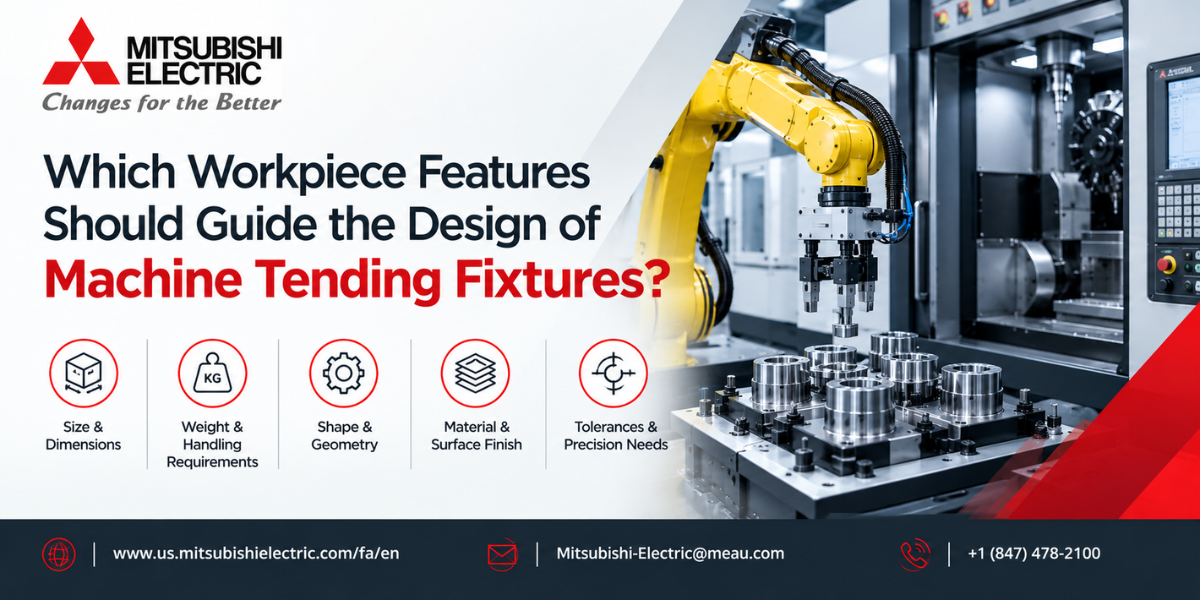
How Workpiece Geometry Influences Fixture Design
The physical shape of a component dictates the locations of contact points. And the way in which the fixture supports the part.
Irregular Shapes and Uneven Surfaces
Simple cylindrical or rectangular pieces are often easy to find and secure. Further issues arise from complexity in sections.
A cast part may have uneven surfaces, projecting parts or limited locations for grasping. The fixture should consider these qualities, and preserve the part in a stable condition.
Surfaces should be chosen which will give secure contact and will not interfere with the machining process. Locating points should be identifiable using consistent geometric traits if possible.
A multi-projection component may require a bespoke nest or contoured contact surfaces. These characteristics help keep alignment during loading and unloading.
Holes, Slots, and Reference Features
Existing holes, slots and machined edges can offer valuable locating points.
For example , pins may locate a metal bracket by two perfectly positioned holes . A cylindrical part can be supported in a V-shaped configuration.
The locating features picked should be constant from manufacturing batch to production batch. Variation may be caused by rough cast surfaces or unfinished edges, which may impact the accuracy of the placing.
Weight, Material, and Surface Finish Affect Gripping Decisions
Two components of comparable dimensions may require distinct handling strategies. Their weight distribution and material qualities can impact the amount of force needed to secure them.
Part Weight and Center of Gravity
Workpiece weight influences robot payload choices, gripping force and fixture strength.
A heavy component puts additional strain on the handling system. If the center of gravity of the part is not at the gripping point, it can rotate or tip as it is moved.
Engineers should evaluate:
- Total workpiece weight and dimensional tolerances.
- Center of gravity and possible imbalance.
- Acceleration and deceleration during transfer.
- Available gripping surfaces.
- Fixture weight and robot payload limits.
These details help determine whether the selected arrangement can hold the component throughout the handling cycle.
Delicate Materials and Finished Surfaces
Aluminium, plastic and thin-walled parts can be deformed under too much strain.
The finished surfaces can also be sensitive to scratches or dings. This is relevant when robots take over part after machining.
The correct solution depends on the material of the work-piece. Also the holding power needed.
Modern robotic grippers can provide customisable force, speed and gripping places. These skills can enable manufacturers to deal with diverse component properties in automated handling applications.
Why Workpiece Orientation Matters During Loading
The fixture must be able to support the required position at each stage of operation. It comprises pick up, transfer, loading and unloading of the machine.
Establishing a Repeatable Loading Position
Repeatable positioning of the workpiece is key to CNC machines. Small positioning errors can compromise the accuracy of the machining or prevent the component from fitting properly.
A carefully constructed fixture will bring the part to a known place.
Many automated systems use a combination of mechanical locating features. Also sensors to verify the presence and correct orientation of the workpiece.
Managing Chips and Coolant
Machined parts can have metal chips, cutting fluid or other residue on them. Such materials can also interfere with touch surfaces and inhibit proper sitting.
Fixtures should be free from unnecessary pockets for the reception of chips. And they’re easily accessible for inspection and cleaning.
The sequence of handling can comprise, as required, air blow-off or cleaning procedures.
These issues become especially critical in machine tending automation. Because the ability to operate without human intervention depends on constant part placement.
Designing Fixtures for Production Flexibility
Features of the workpiece may vary from product to product version or from batch to batch. The manufacturers should be asking if the fixture will hold one component or multiple related designs.
Accommodating Multiple Part Sizes
High-mix manufacturing environments often require frequent changeovers.
Adjustable locating points, interchangeable jaws, and modular fixture components can help accommodate different workpieces.
This is also relevant to material handling automation. Where consistent part presentation supports smooth movement between production stages.
Planning for Inspection and Maintenance
Fixture components experience repeated contact, vibration, and exposure to shop-floor conditions.
Contact surfaces may wear over time. Locating pins can become damaged, and debris may collect around moving elements.
Designers should make frequently inspected components accessible. Replaceable contact pads and straightforward adjustment procedures can simplify maintenance.
Frequently Asked Questions
What is the most important feature when designing a machine tending fixture?
Usually the starting step is workpiece geometry. But weight, material, gripping surfaces and position needs must be considered too. The best design is to think about these features together.
Can one fixture handle different workpiece designs?
Yes. Modular components and flexible grasping configurations may adapt to a variety of item sizes and shapes. Each configuration must be checked. That helps to make sure it is secure and in the right place.
How can manufacturers identify fixture design problems before production?
Testing on sample workpieces might show alignment issues, insufficient gripping force, interference and difficult release conditions. Repeated cycle testing can help uncover flaws that may not be discovered during initial setup.
Conclusion
The secret to a good fixture design is knowing the part you’re working with. Geometry constrains placement possibilities. Weight affects the demands on the grip. Material properties affect contact pressure. Surface conditions affect repeatability.
Manufacturers should additionally consider production variance, machine accessibility and maintenance requirements prior to design approval.
Machine tending fixtures designed according to the characteristics of actual workpieces can facilitate more repeatable loading and protect finished components. Also improve the reliability of automated machining operations.